Articles | Updated 19 November 2026
What is MRP: planning materials from a BOM step by step, with an example
MRP stands for Material Requirements Planning. It works out, for the quantity customers ordered, which materials are needed and how much, how much is already on hand, how much more to buy, and by when to order so it arrives in time to produce. MRP starts from the BOM, the production recipe.
What data MRP uses
MRP works from 5 pieces of data; if any is wrong, the plan is wrong too
- The quantity to produce, from sales orders or the production plan
- The BOM, which says what materials one batch uses and how much of each
- Stock on hand of each material
- Goods already ordered and on the way
- Lead time: the days from ordering until goods arrive, or the days needed to produce
How MRP calculates
MRP works in 3 steps, repeated for every material
- Step 1, explode the recipe: multiply the quantity to produce by the BOM to get the gross requirement for each material
- Step 2, net off what you have: gross requirement minus stock on hand minus goods on the way gives the quantity to buy; a negative result means you already have enough
- Step 3, work back the date: the order-by date is the need-by date minus the lead time
Example: 120 jars of chili paste
Using the same recipe as the BOM article, one batch makes 40 jars. A wholesaler orders 120 jars for delivery on 10 December, so 3 batches are needed. Production takes 2 days, so it must start on 8 December.
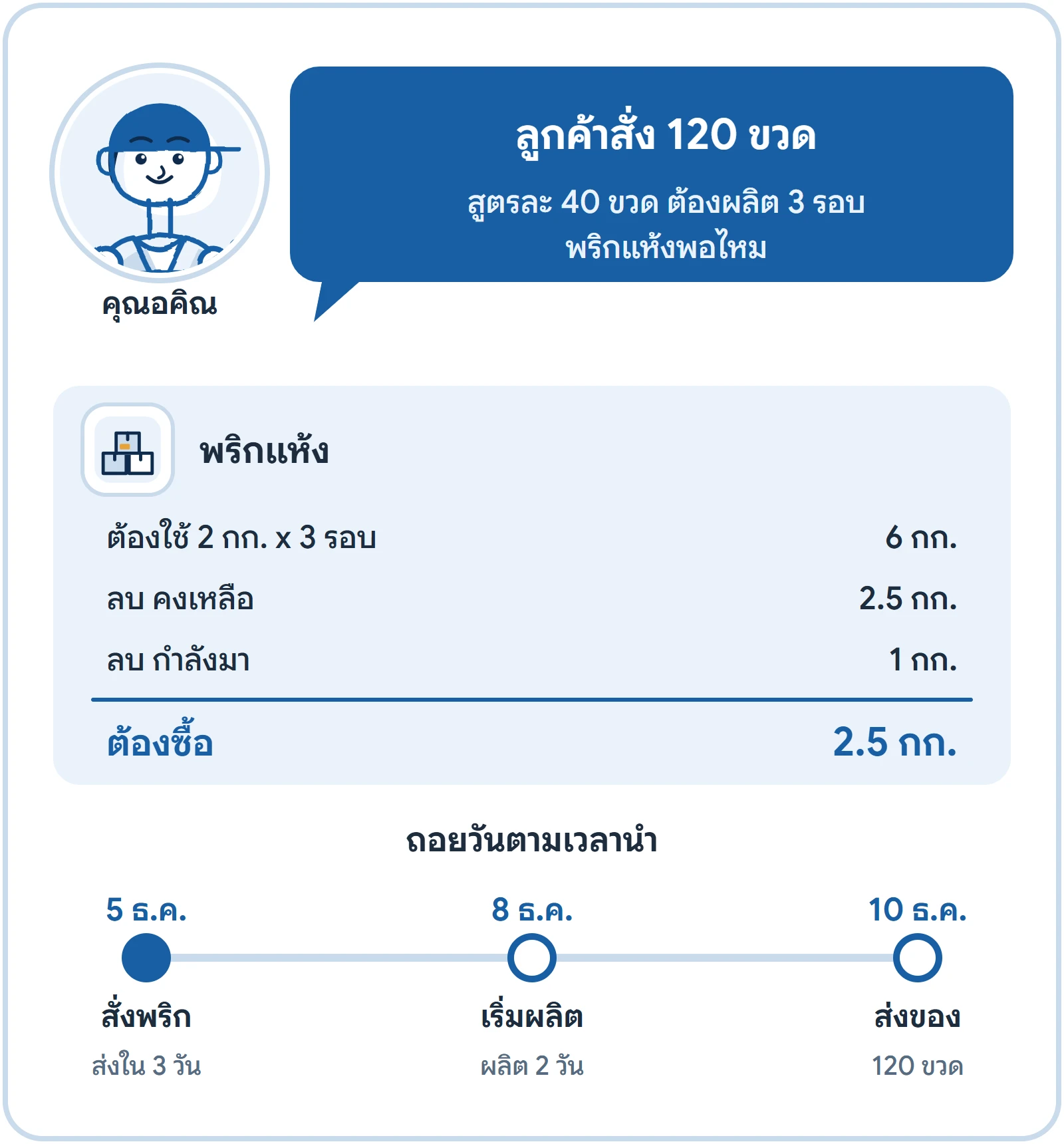
- Dried chili takes 2 kg per batch, so 6 kg for 3 batches. With 2.5 kg on hand and 1 kg on the way, 2.5 kg more must be bought.
- The chili supplier delivers in 3 days and the chili must arrive before production starts on 8 December, so it must be ordered by 5 December.
- There is exactly enough shallot, so none is needed, but if another job uses shallot in the meantime, recalculate.
Dried chillies
Needed for 3 batches: 6 kg
Remaining: 2.5
On the way: 1
To buy: 2.5 kg
Shallots
Needed for 3 batches: 9 kg
Remaining: 9
On the way: 0
To buy: None needed
200 g glass jars
Needed for 3 batches: 120 jars
Remaining: 50
On the way: 0
To buy: 70 jars
| Raw material | Needed for 3 batches | Remaining | On the way | To buy |
|---|---|---|---|---|
| Dried chillies | 6 kg | 2.5 | 1 | 2.5 kg |
| Shallots | 9 kg | 9 | 0 | None needed |
| 200 g glass jars | 120 jars | 50 | 0 | 70 jars |
How MRP differs from BOM and ERP
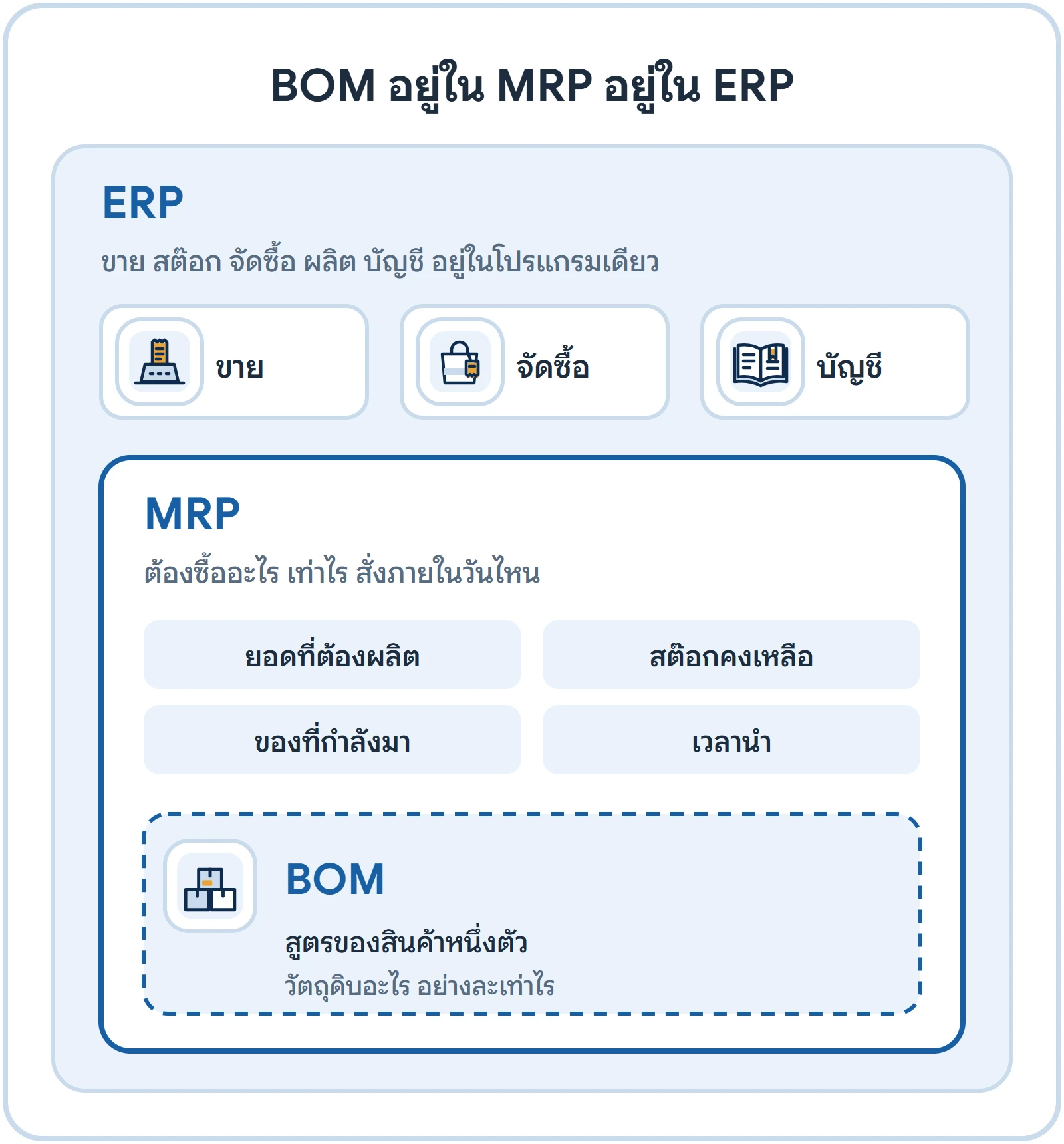
A BOM is the recipe for one product. MRP is the plan that uses the BOM to decide what to buy and when. ERP is software that brings sales, stock, purchasing, production and accounting together, so MRP is one of the jobs inside an ERP.
Some people mention MRP II, short for Manufacturing Resource Planning, a broader plan covering materials, labor, machines and money. Most small factories do fine starting with material MRP.
How a small business starts with MRP
- Complete the BOM for every product you make, including packaging
- Get your material stock count right first; wrong on-hand figures make the plan buy the wrong amounts
- Enter lead times for key materials and the days needed to produce
- Record every sales order and purchase order in the system so the plan sees both what must ship and what is on the way
MRP in GORINY
The requirements planning page under Inventory combines undelivered sales orders, production recipes, stock and purchase orders already sent to suppliers, then splits items into what to produce and what to buy, with quantities, need-by dates and order-by dates. Overdue items get a red label. You can create purchase orders per supplier or production orders from the same page.
Good to know: the page only calculates and does not touch stock until you create a document. Draft purchase orders do not count as on the way. Production quantities are not rounded to the batch yield, and goods on the way count in full regardless of arrival date. Creating production orders from the plan needs a package with the production module.
Read how to build a BOM and work out cost per unit in the article What is a BOM
Frequently asked questions
- What does MRP stand for?
- Material Requirements Planning: planning what materials you need.
- Can a shop that buys to resell, without producing, use MRP?
- Yes, with the same idea: take what customers ordered, subtract what you have and what is on the way, then work back by the supplier's delivery time. There is just no recipe step.
- How is MRP different from a reorder point?
- A reorder point only checks whether stock has fallen below a set level. MRP looks at what actually has to be produced or shipped, what is on the way and when it is needed, so it gives both the quantity and the order-by date.
Related features
Get new articles and ask about store tax on LINE
Add GORINY's LINE OA as a friend. We only send things your store can actually use.
Get articles like this by email
1 to 2 emails a month, unsubscribe anytime
Try it with your own store's data
Sign up yourself right away for a free 14-day trial, then you decide whether to continue. Or try the sample shop first.