Articles | Updated 21 November 2026
Hidden Costs of a Shop: The Money Lost Below the Iceberg
Most shop owners know they gave the wrong change a few times this month. The bigger money usually disappears quietly in the part nobody sees, like an iceberg that shows only its tip. This article shows where hidden costs sit in a shop, how much they add up to, and how to see them before the money is gone.
What are hidden costs?
Hidden costs are money the shop really loses but that has no receipt, is not in the books, and was never paid out directly. Examples are goods that vanish from the shelf, input VAT that could be claimed but never was, or items sold below their new cost because nobody noticed the supplier raised prices. These costs are never recorded, so nobody hurries to fix them.

The example shop behind the numbers
To make it concrete, take one retail shop that sells 300,000 baht a month, with a cost of goods sold of 240,000 baht a month, VAT registered, with 2 counter staff. The figures below are a hypothetical example; every real shop is different.
The visible part: problems the owner feels every day
Together that is about 5,300 baht a month, or 63,600 baht a year, money most owners already roughly know about.
- Wrong change: 50 baht a day, or 1,500 baht a month
- Cash drawer short: 100 baht a day, or 3,000 baht a month
- Shelves running empty unnoticed: 1,000 baht of lost sales a week, about 800 baht of lost profit a month
- Writing sales down twice: 1 hour a day, 30 hours a month
Below the water: 5 hidden costs nobody sees
These 5 add up to about 85,380 baht a year, roughly 1.3 times the visible part.
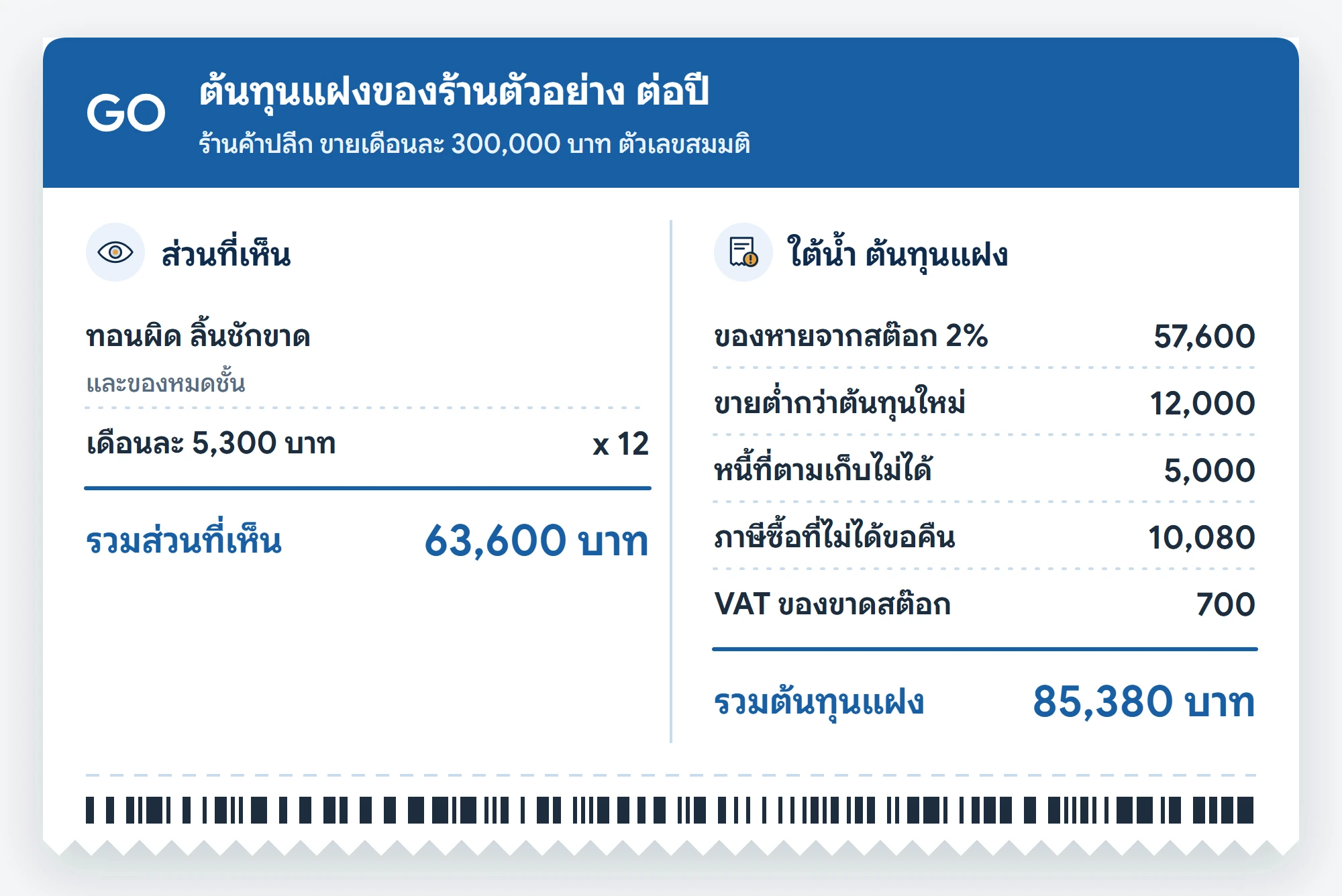
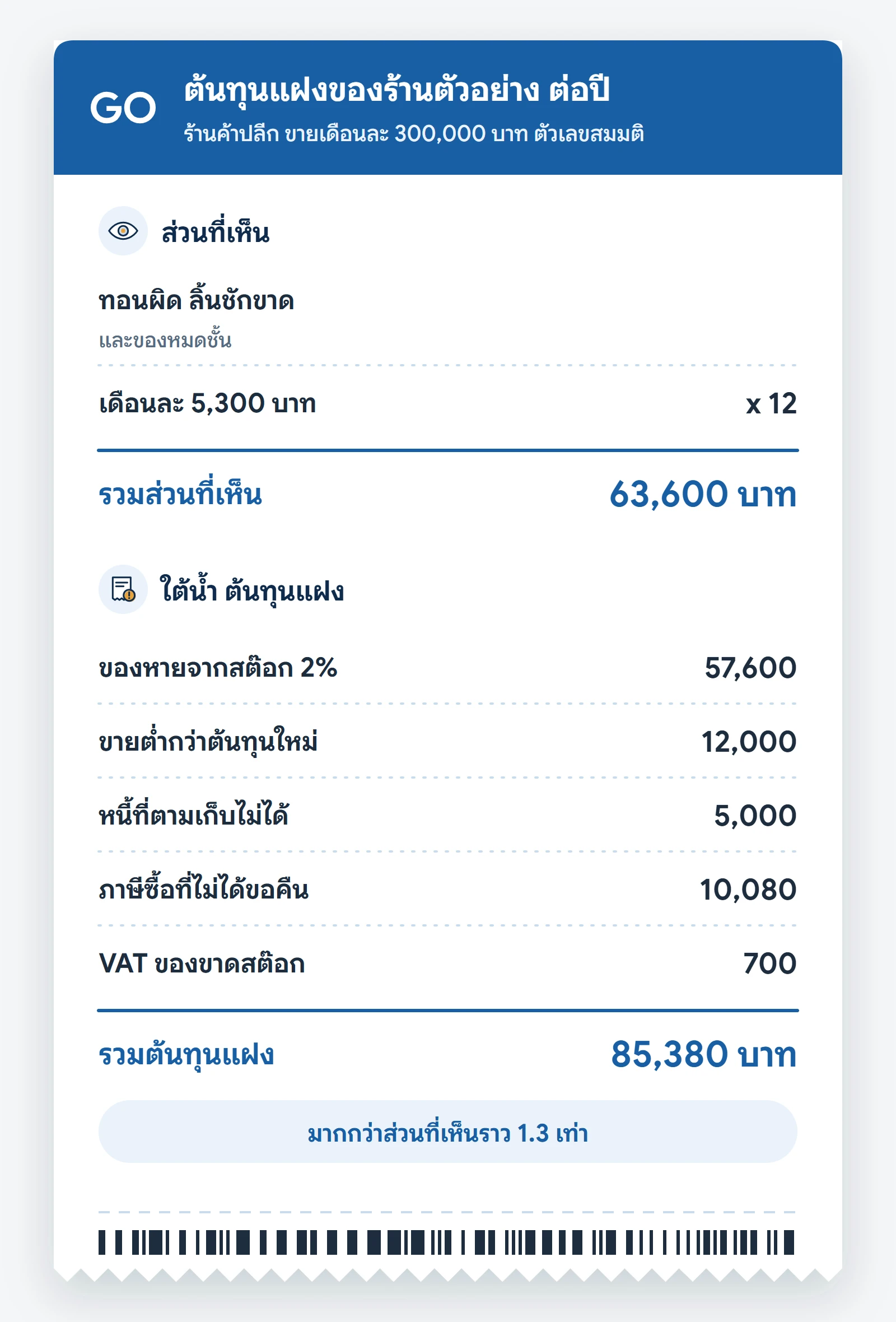
- Missing stock: spoiled or expired goods, or goods taken for use without a record. Losing 2% of 240,000 baht of cost is 4,800 baht a month, or 57,600 baht a year. A shop with no on-hand figure to compare against never knows how much is gone.
- Selling below the new cost: the supplier raises prices 5% on items that sell 20,000 baht a month, but the shop keeps the old price. Profit drops 1,000 baht a month, or 12,000 baht a year.
- Credit sales never collected: debts written in a notebook have no reminder of how long they are overdue. Assume 5,000 baht this year is never collected.
- Input VAT never claimed: tax invoices from suppliers get mixed with other bills or lost. If 5% of 240,000 baht of purchases is lost, the shop gives up 840 baht of claimable input VAT a month, or 10,080 baht a year.
- Stock shortages become tax: a VAT registered shop that sells goods must keep a goods and raw materials report. If a count finds less than the report shows, the Revenue Department treats the shortfall as a sale. A 10,000 baht shortage means 700 baht of VAT, possibly with a penalty. Paying VAT late adds a surcharge of 1.5% a month on the tax due.
Hidden costs you cannot put a number on
The owner can never take a day off because every number lives in one head, stock is ordered on gut feeling until cash is tied up in goods that do not sell, and recorded figures get changed afterwards without a trace.
How to bring hidden costs to the surface
Hidden costs shrink once the owner sees them as numbers. You can start right away, even without software.
- Count your top 20 best sellers every month and compare with what should be left
- File every purchase tax invoice when goods arrive, and hand them to your bookkeeper at month end
- Compare the latest purchase price with your selling price every time a supplier announces a price rise
- Keep a list of customers who owe you with purchase dates, and follow up every one over 30 days
How GORINY shows you what is below the water
If doing it by hand cannot keep up, software makes the numbers appear as the shop sells and receives goods. In GORINY the stock count page shows at once how much each item is short and posts the difference to the books. Each time goods arrive, the system recalculates average cost so you see the profit on each item. The receivables aging report shows who owes and for how many days. Purchase bills recorded with their tax invoice numbers roll up into the input tax report and a draft PP.30 for your bookkeeper to check before filing.
The system does not file taxes for the shop, and annual financial statements still need your bookkeeper to check them. But the owner sees hidden costs as numbers every month, instead of finding out after the money is gone.
Frequently asked questions
- How are hidden costs different from sunk costs?
- Hidden costs are money lost without noticing that can keep being lost, while sunk costs are money already spent that cannot be recovered, such as shop fit-out. Hidden costs are therefore something the shop can still fix.
- Does a small shop that is not VAT registered have hidden costs?
- Yes. Missing stock, selling below the new cost and uncollected debts can happen to any shop. Input VAT and the goods report only concern VAT registered shops.
Sources
Checked against official announcements on 21 November 2026
Related features
Get new articles and ask about store tax on LINE
Add GORINY's LINE OA as a friend. We only send things your store can actually use.
Get articles like this by email
1 to 2 emails a month, unsubscribe anytime
Try it with your own store's data
Sign up yourself right away for a free 14-day trial, then you decide whether to continue. Or try the sample shop first.